 |
LUNA NERA: PLAYING IN/ON THE URBAN DESERT Hilary Powell and Gillian McIver Champ Libre event "Desert" -- The Des Carrières incinerator Montreal 26.09.04 |
Part One – PLAYING IN THE URBAN DESERT
In this presentation we discuss how we see our work as a form of intervention into the urban environment. We believe that putting our art practice in the marginal space contains within it an element of playfulness, while at the same time dealing with serious issues of identity, location, culture, ownership, transition and regeneration in the urban landscape. Our practice takes us to sites away from our own locality and part of our practice is to connect to the new locality and draw material and inspiration from it, rather than imposing our work on a foreign environment. As artists we participate – locally and in a wider sphere - in urban regeneration and thus accept the equation of art and urban renewal. However we believe that artists need to begin discussiing together what exactly is our role in this process and what do we hope to gain.
Deserts
We understand the theme "Desert" in relation to urban wasteland and cast off "useless" spaces. As outpost territories in mutation they "radiate" intense possibilities that we wish to highlight and harness. Our preoccupation is the retrieval and recycling of a landscape fallen out of a system of production. For us, the urban Desert involves the complex wastelands created through the changing patterns of use and value in the cityscape. Although most of our projects are situated in deserted buildings and structures of the city our research and ethos applies to other in between and forgotten sites in the city from waste lots to abandoned swimming pools.
On a global, historic scale deserts and droughts are not permanent, - radar images from the space shuttle reveal evidence of ancient forested river valleys where the Sahara now exists. This fragility and instability is seen accelerated on an urban micro level. Within the constantly shifting sands of the urban landscape we seek out the deserted spaces in order to use them as both source and resource and create new sites of play and imagination. Our process of searching and researching can be seen as pseudo- archaeological -uncovering and extracting choice facts and fictions of a site and composing them in new constellations.
To desert/ to abandon
Luna Nera sees such sites as junk for "If space-junk is the human debris that litters the universe, junk-space is the residue mankind leaves on the planet." (Rem Koolhaus. Junkspace) To desert is to abandon, and abandonment is the very process that makes spaces and materials junk. However such sites and buildings are not rubbish …they have not escaped altogether into entropy … The very definition of junk implies its potential for re-use. It is differentiated from rubbish as waste or worthless material -excess from a system of production, leakage from a general economy. Garbage presupposes decomposition, Junk lies on the edge of this system, its destiny unstable and open to changes in time, use, value and function.
Just as the leftovers and traces of humankind’s production orbit the earth, junk sites and objects circulate the urban environment awaiting re entry and transformation by the forces of urban renewal - dual narratives of urban demolition and preservation. Operating in these "in between’ spaces in between these temporal processes we believe in the potential to "put to use" not in terms of original purpose or functionality but as part of a temporary rejuvenation of these ‘lost’ sites though artistic appropriation.
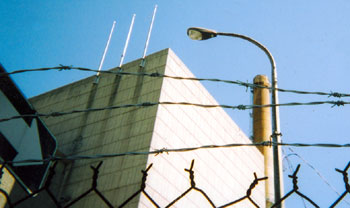
The Des Carrières incinerator With all this talk of waste we cannot avoid the site of this "Desert’ art event. As an urban landmark to an industrial past, the Des Carrières incinerator can be described in the words of Robert Smithson as a "non-ument" ….a monumental vacancy defining the " memory traces of an abandoned set of futures". Smithson’s practice was based on a central belief in an entropic landscape or ruins-in reverse with the aim of creating an alternative history constituted through its physical fallout- from buildings to dumpsters, suburbs and sewers.
Here, despite its history and original function as a gigantic waste disposal unit the programme is not all entropic. Just as it used to be equipped with a state of the art heat recuperation system, recycling energy - ‘ recycling" is now applied to both the function and meaning of the site. Here Champ Libre shares Luna Nera’s aims in provoking experience and debate around a particular site’s potential urban future and the related issues of waste, value and regeneration. - creating new energy and activity and rousing renewed public perception of the site- re-inscribing it into local consciousness as a space of potential.
Part two - LUNA NERA’S PROJECTS
East into West – Desertification and renewal One wellknown and emblematic work which refers to this process is Wim Wender’s 1987 film "Wings of desire" which showed the spaces of transformation and change in Berlin’s divided cityscape. The film shows urban desert sites as charged with history and memory. The storyteller wanders on the Potsdamer Platz and cannot believe that this space was once full of trams and people as he remembers the changes he has lived through. Wenders understands that seeing these urban desert sites as poetic or metaphysical entities is overlaid with an awareness of the complex economic and social - political vectors that form and shape them. Scars are present in the landscape .,…collective memories of pain and destruction … emphasising the fact that the desert is never empty.
Since Wender’s made the film, rapid change has taken place and Potsdamer Platz is now full of showcase architecture. Luna Nera’s work takes its place in the same gaps in time and space that exist between dereliction and this kind of redevelopment. It highlights the fact that when the chosen sites are the unstable buildings of the city, the balance of the poetics and politics of space is a precarious one involving complex arguments of use and responsibility. In Berlin the group has worked in the factory halls left standing but empty in the declining industrial area of Oberschöneweide, in former eastern Berlin.
This area was built by AEG as the primary industrial section of the city, the most innovative and modern centre for the electrical industry. In the early 90s the area sunk overnight into unemployment and decay; today it is well off the tourist and art map of trendy Berlin. Luna Nera has joined with Group Tiefenrausch Ost, which is based in Oberschöneweide, to create projects out of the fabric of the district.
A related and not dissimilar site is Kronstadt, an island off the coast of St Petersburg where the group worked in 2003 and 2004. This military island was once the showpiece of the Tsarist and Soviet navy, it now suffers from decay and 60% unemployment. The challenge was to treat the site with sensitivity while attempting to unpick the layers of history and social change that have created the urban landscape.
Both of these sites offer not only a wealth of fascinating and unique architecture, but are also highly populated. This situation - the unseen and unacknowledged yet well-populated "desert" as a site for socail and artistic action challenges and opens up the question of the role of art in daily life. By intervening in these sites we are not only engaging with the physical space of a building but engaging with the social culture of the locality and all that this involves.
No water in the desert - Empty Pools Our projects also bring up the questions surrounding use and disuse, public access and property rights and urban renewal strategies. In the inner city park of London Fields in Hackney, east London there is a walled and inconspicuous space. Closed since 1988 the London Fields outdoor Lido was home to a number of squatter residents inhabiting the changing rooms, old café and boiler room that surround the drained pool basin.
After meeting the residents and asking if it was possible to work in the empty pool artist Hilary Powell created a project called "Fleeting" which became a romantic take on the "seaside in the city" development of leisure culture in the 1920s. This is turn bore within it a comment on the disuse and neglect of leisure spaces in contemporary London, as this site among many similar, lies abandoned.
Public consciousness always seems to retain a fascination with these kind of spaces, as seen by the competition to use the empty pools of London for events but there has to be a real relationship between the site and the work’s process and realisation. For example - these pools were intended for a certain use and in most if not all cases their closure was not supported by the public that they were built to serve. This opens up many exciting questions; for instance, how has our notion of leisure changed over time? Merely using a space as a substitute for a traditional gallery misses the point, which is to highlight the inherent potential in these urban desert spaces, reclaiming them as fertile creative ground for imaginative play and action.
Oasis / Mirage Image There remains a certain paradox as the urban desert itself becomes an oasis for creative production and site for events of difference and affect. With the nomadic work of Luna Nera there are also associations with the phenomena of the Mirage as an optical illusion caused by atmospheric conditions. Each event produces its own transitory and illusive micro-climate and atmosphere drawing people into spaces that are previously uninviting and forsaken, invoking a re- awakened awareness of these solid yet somehow ‘"invisible" sites.
Historical accounts suggest that mirages themselves have been a starting point for global exploration; as temperature inversions in the atmosphere cause a kind of mirror effect revealing places hidden under the curve of the earth and transmitting them across hundreds of miles…e.g. reported sightings of apparent flying ships, cities in the sky and new coastlines. Dozens of islands marked on old maps were in fact just mirages.
But Luna Nera’s practice is not about building fantasy castles in the air. The point is that mirages incited exploration and renewed perception of the possible. Our work involves elements of phantasmagoria and surrealist dream spaces to provoke a renewed perception of abandoned urban sites and the potential they hold. It encompasses the everyday fantasies and projects that keep human beings going As event spaces they provide these glimpses of split seconds of paradises or utopian possibility and in turn, aim to have a longer term effect on the way desert spaces are viewed and understood.
Each event we have made inscribes itself into landscape and memory but in effect what we show now is a document of disappearances or a journey through ruins. Through our projects, our main concern is for the activation of place and memory and the creation of spaces of difference and affect. We wish to work with and highlight the deserted sites of the city as paradoxical spaces of freedom and fertility existing between the dual processes of urban progress and destruction…..
Conclusion We are interested in the play between past present and future of specific sites. Ours is not a preservationist or heritage agenda where plaques are erected and sites are assigned status as places of memory. It is not about creating a kind of "theme park" of history but about utilising and amplifying present space and atmosphere. The work needs to exist in symbiosis with its site allowing the intermediary, tentative and dynamic spaces that these events occupy and form to move people as they perceive some sort of leap into the extraordinary. In forlorn and derelict spaces such active engagement could be seen as a form of exorcism- where new energy could stir up the ghosts of memory as well as dust - confronting the past through the present intensive activity and in turn creating new hauntings.
===== "nothing can release life from its obligation to be absolutely passionate" (Lettrist International)
thanks to CHAMP LIBRE HTTP://WWW.CHAMPLIBRE.COM and THE BRITISH COUNCIL